
I bring a deep interest in language, culture, and history to everything I do. From early on, I’ve been drawn to how people make meaning across different worlds — whether through literature, translation, or shared stories. That perspective continues to inform my work today: I value intellectual curiosity, cross-cultural understanding, and the power of communication to bridge divides and build connection.
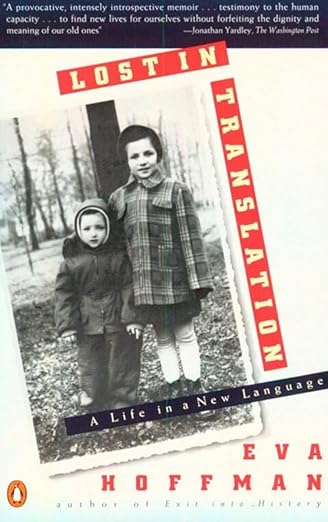
I was “lost in translation” as an eighteen month old when my family returned to Northampton,
Massachusetts after a year in Jerusalem. I did not know the English word “water”; I only said the Hebrew
“mayim.” My parents translated for the daycare teachers. As a toddler, I did not possess the self-
awareness to understand the significance of my experience. Now, years later, after reading Eva
Hoffman’s memoir Lost in Translation (1989), the meaning of that memory is more resonant.
Hoffman’s memoir offers insightful ruminations on immigration, language, and culture from her
perspective as a Polish immigrant to Canada in 1959. Initially, as an adolescent and even as a young
adult, she struggles to express herself in a new language and discovers that some thoughts simply cannot
be translated and are lost. Yet her unique situation also makes her keenly aware of cultural nuances –
nuances, ironically, often lost on others. Cultural relativity becomes her métier; Poland, Canada, and the
United States, her points of reference. Hoffman does not feel the pull of one culture, but of many. “New
York, Warsaw, Tehran, Tokyo, Kabul—they all make claims on our imagination…we are always
simultaneously in the center and on the periphery” (Hoffman 275). As an immigrant and a deft observer
of culture, Hoffman has the ability to recognize the fallacy of absolutism and the truth of pluralism.
Her unique perspective has attuned me to the challenges immigrants face and has intensified my
desire to understand other cultures. After all, being lost in translation relates not only to the literal barrier
of language, but the figurative barrier of culture. Such a barrier exists when one limits herself to her own
immediate experience. A singular frame of reference can be static and dull. Without knowledge and
appreciation of other cultures and of history, I would be confined solely to my own world in the
immediate present. I would be robbed of a medium of translation between one world and another.
My reading, study of foreign languages, and fascination with history have made me aware of the
many forces and dimensions beyond myself. Besides one’s own immediate experience, there are one’s
personal past and one’s imagination. Further, there are the collective historical past and the simultaneous
existence of many cultures. The multifocal cultural lens Hoffman exhibits is one that I have tried to
develop. Studying foreign languages, especially Latin and French, has allowed me to do this. Certain
Latin expressions like adversus solem ne loquitur – “don’t argue against the sun” – do not have adequate
English equivalents. Their meaning is unique to the place and time where they were spoken. Similarly,
history deepens my understanding of cultures not readily accessible. When I read the poetry and
harrowing accounts of the Soviet writer Osip Mandelstam, I am vicariously transported to the harsh
realities of Stalinist Russia, though that world no longer exists. Words and books immortalize the
experiences of people whose stories would otherwise seem distant and unattainable. Their accounts
become my points of reference. I begin to understand the popular wisdom of another time and how a
society should not be subject to repression. As I translate their lives to our day, I derive lessons
concerning ethics and politics. Consequently, I am not lost in translation between different cultures or
periods because I realize that each offers lessons for all others.
The state of being lost in translation need not be permanent. By choosing to value others’
experiences and reflections, I venture into the realm of translation. When my own frame of reference
seems limited, I seek the perspective of another, whether it be Hoffman, a wise Roman, or Mandelstam. I
integrate the thoughts of others so that they inform my own. Only with an array of diverse and insightful
views can I fully understand myself. A translation of self does truly require the world.
 Naomi Braude | Writer & Communications strategist: Building impact through words, strategy, and digital storytelling